
Download a printable version of this guide here.
Judging a cactus and succulent show is as much an art as it is a science. While general principles apply, there are no universal rules—practices vary among clubs, and a degree of subjectivity is inherent in every decision. The criteria outlined below are intended as guidelines rather than a strict scoring system. Judges bring their own experience and perspective, and may weigh factors differently. Depending on the experience level of its members, each club may decide on its approach to ranking the entries.
Two primary approaches to judging are commonly used:
One approach evaluates plants against an ideal standard of perfection. Under this method, awards are given only if a plant meets that standard. As a result, even if there are only a few entries in a class, no first, second, or third place may be awarded if none are deemed worthy.
The more commonly used approach evaluates plants relative to one another. In this case, entries are ranked within the class, and first, second, and third places are awarded even if only a few plants are exhibited.
The following represent broadly accepted judging considerations in order of weight.
| Criterion | Typical Weight | Notes |
| Horticultural Merit | Highest | Health, vigor, symmetry, maturity, color, and flowering |
| Conformity to Species | High | Does it look like what it should look like? |
| Difficulty of Culture | Moderate (varies) | Recognition for slow-growing or hard-to-cultivate species |
| Cleanliness and Grooming | Moderate | Clean plant, pot, and soil surface |
| Potting and Staging | Lower | Container choice, proportion, and top dressing |
| Nomenclature | Lower (varies) | Correct identification and labeling |
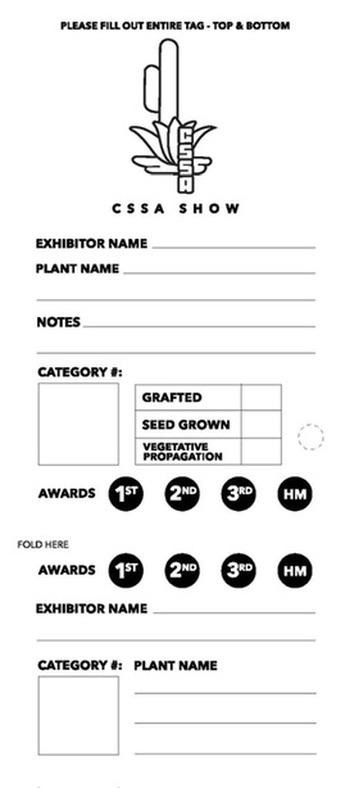
📌An example of a scorecard is included at the end of this guide.
Judging Criteria
Horticultural Merit
Plant health and vigor are generally considered the most important factors. A flawless, healthy plant will almost always place higher than a rare but poorly grown one.
- Health and Vigor — Free of pests, disease, scars, and damage
- Symmetry and Form — Balanced, natural growth habit
- Maturity — Plants grown slowly over time are preferable to plants forced or pushed to grow rapidly
- Color — Natural, species-appropriate coloration
- Flowering —When applicable, abundant, well-formed blooms in proportion to the plant
📌CSSA and many affiliated societies prohibit the exhibition of field-collected plants in shows and competitions. Affiliates are strongly encouraged to adopt similar conservation-focused policies.
Conformity to Species
Judges consider how closely a plant matches what it should ideally look like — its natural form, size, texture, and color as described for the species.
Difficulty of Culture
Consider giving additional recognition to plants that are notoriously difficult to grow or are slow-growing. This is a subjective consideration, and its weight varies by show. Specimens grown from seed may be indicated and given special consideration.
Cleanliness and Grooming
Presentation matters. Plants should be clean and naturally groomed; grooming or pruning should not look artificial or forced.
- Plant — No dust, hard water marks, spider webs, or dead leaves
- Pot — Clean, no mineral deposits or grime
- Soil surface — Tidy top dressing, free of weeds or debris
📌Plants with active pest infestation or disease, once identified, are immediately disqualified and removed from the show area prior to judging, as directed by the Judging Coordinator.
Potting and Staging
Staging — including the container, top dressing, and any accompanying rock or wood — is usually a smaller portion of the overall evaluation, but it contributes to the overall impression.
- Container size and shape — Pot is proportionate to the plant, with shape complementing growth form and root structure. Judges look for a composition where neither the plant nor the container overwhelms the other.
- Container color — Neutral or muted tones are generally preferred; bright colors can distract from the plant
- Top dressing — Neat, appropriate in scale, and complementary to the plant
📌In some shows, the container and staging may carry more weight than in others – this varies by organization.
Nomenclature
Make certain that classification is correct and current; misidentified plants may be marked down.
Judges may note errors for exhibitor learning.
Show Structure and Entry Classes
Show structure consideration should be tailored to the size of the club and the expected number of entries. Please refer to the companion document Planning a Cactus and Succulent Show and Sale.
Entry Classes
In order to promote increased participation, some shows separate entrants by experience instead of having a single open class. For example, Novice, Intermediate, and Advanced levels do not compete against each other.
Plant Groupings
Larger shows may group plants by genus or specialized category:
- Miniatures, variegated plants, and crested / monstrose forms
- Seed-raised plants, succulent bonsai, educational displays, and related artwork
Smaller shows typically use broader groupings and plants are judged within their class:
- Cacti, other succulents, caudiciforms, mesembs, and specimen plants
The Judging Process
The following reflects a typical process, though details vary by organization. In a large show, judges are assigned to a specific group such as cacti or succulents. Small shows do not require this division.
| Step | Description |
| Selection | Seek judges with strong experience in succulent culture; designate clerks from among club members to assist judges and gain experience to become future judges |
| Evaluation | Plants are assessed within their class, To reduce bias, Judges should not know exhibitors’ names (see sample scorecard) |
| Award Categories | First, second, and third placeHonorable mention ribbon (Judges’ choice)Best in Show (typically the best plant entered by judges consensus) |
| Recognition | Most clubs recognize their show winners with ribbons, plaques, or occasionally pots. Winners may also be featured in newsletters. |
Which Entries Tend to Win
While no formula guarantees a winner, the plants that consistently do well share certain qualities:
- Perfectly grown — not forced, rushed, or recently repotted
- Excellent natural symmetry and mature appearance
- Immaculately groomed, with no distracting elements
- Clearly and correctly represents its species
Rarity does not equal quality — quality beats rarity.
Further Resources
For a deeper look at judging practices, see the information listed below
CSSA webinar So You Want to Know More About Cactus and Succulent Judging by Joe Clements (December 21, 2024), available on the CSSA website under webinars.
The British Cactus and Succulent Society (BCSS) Handbook of Shows 11th edition 2021, presented by the British Cactus and Succulent Society.
Download a printable version of this guide here.
Scorecard Example
Download a printable version of this guide here.